


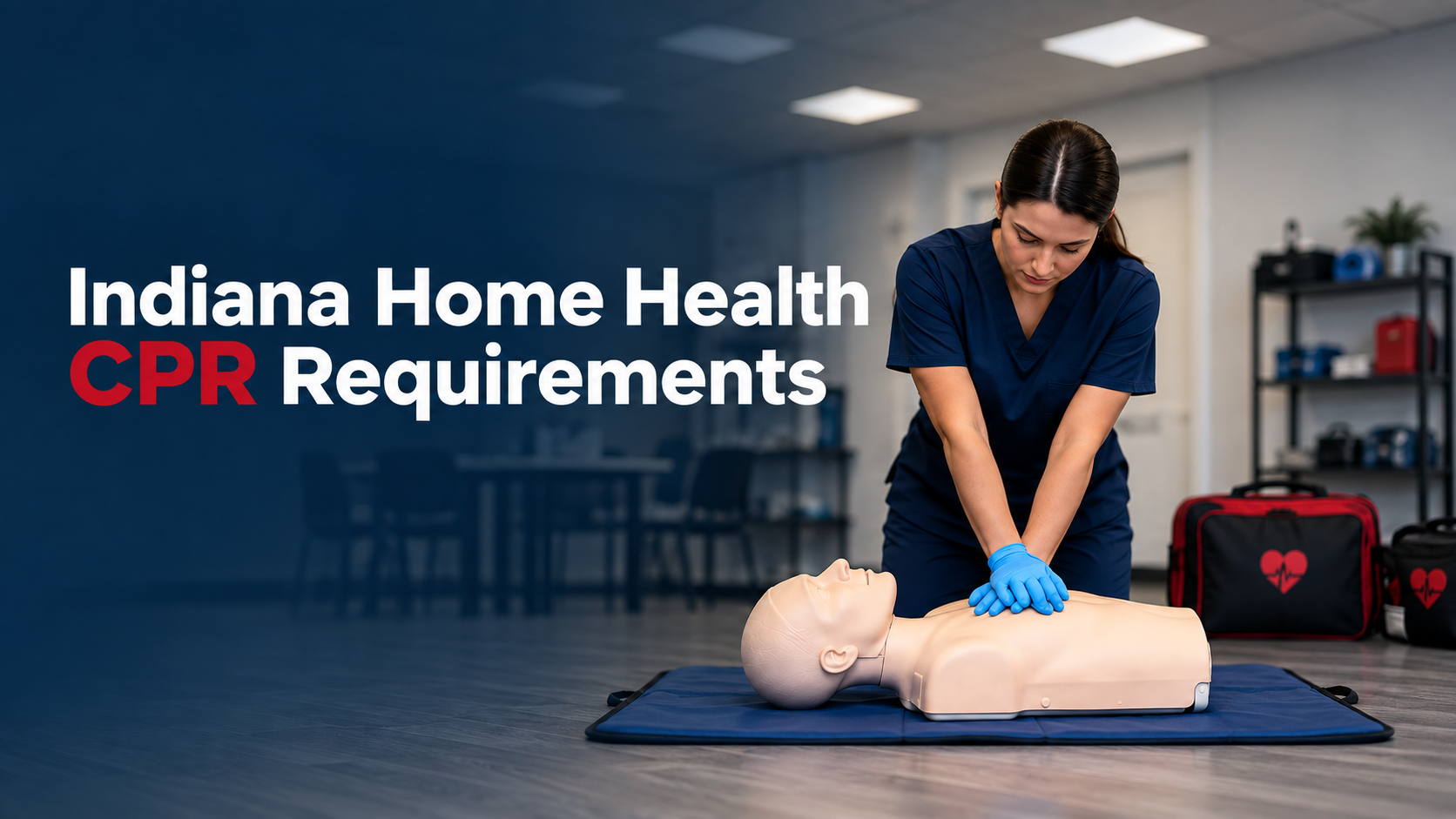
Does Indiana Require CPR Certification for Home Health Care Workers?
Does Indiana Require CPR Certification for Home Health Care Workers?
Updated September 2026
If you work in home health care or direct care in Indiana, you may have questions about CPR certification.
Does Indiana require CPR certification for home health care workers?
The answer depends on the type of provider and the services you provide. Indiana has specific CPR requirements for certain Home- and Community-Based Services (HCBS) waiver providers. Traditional home health agencies follow different requirements.
Here is what the current Indiana guidance says.
Quick Answer: Yes, some home-care workers in Indiana are required to have current CPR certification.
Indiana Medicaid requires direct-service staff who work under applicable HCBS waiver programs to complete CPR and first-aid training. These workers must also maintain current CPR certification from an approved organization.
However, the rules are different for traditional home health aides. Indiana’s Department of Health says home health and hospice agencies establish their own HHA training policies. Those policies must still follow applicable state and federal requirements.
What Changed in Indiana?
Indiana clarified its CPR requirements for HCBS waiver providers in February 2025. On February 4, 2025, the Indiana Family and Social Services Administration (FSSA) issued IHCP Bulletin BT202517. The bulletin explains the CPR and first-aid requirements for direct-service staff.
First, these workers must receive CPR and first-aid training. In addition, they must have current CPR certification.
The certification must come from an approved organization. For example, FSSA lists the American Heart Association and American Red Cross. The provider must also keep the CPR certification and first-aid training records in the employee’s personnel file.
Who Needs CPR Certification in Indiana?
The HCBS requirement applies to direct-service staff. FSSA specifically mentions:
- Direct Support Professionals (DSPs)
- Patient Care Aides (PCAs)
- Other direct-service staff covered by the applicable HCBS waiver program
These employees must receive CPR and first-aid training. They must also keep their CPR certification current.
Most importantly, the training must be completed upon hire and before face-to-face interaction with clients.
Do Home Health Aides Need CPR Certification in Indiana?
This is where things can get confusing.
Indiana has separate requirements for Home Health Aides (HHAs).
The Indiana Department of Health says home health and hospice agencies are responsible for establishing their own HHA training policies. Each agency must still follow applicable Indiana and federal requirements. Therefore, there is not one CPR rule that applies to every person who works in home health care.
The requirements can depend on:
- The type of provider
- The services being provided
- The Medicaid program
- State requirements
- Federal requirements
- The employer’s policies
If you are unsure which rules apply to your position, check with your employer or the appropriate Indiana agency.
What CPR Certification Does Indiana Accept?
For applicable HCBS waiver direct-service staff, FSSA requires CPR certification from an approved entity.
The Indiana guidance gives the following examples:
- American Heart Association (recommended)
- American Red Cross
Your employer may also have additional requirements. For that reason, check with your employer before choosing a CPR course.
Does CPR Training Need a Hands-On Skills Test?
The right CPR course depends on your employer or program requirements. Some CPR courses are fully online. However, American Heart Association and American Red Cross certifications require an in-person skills component. You can complete the training either fully in person or through a blended format. With blended learning, you complete the coursework online and then attend an in-person skills session with an instructor.
With blended learning, you complete the course work online. Then, you complete a hands-on skills session with an instructor.
How Often Does CPR Certification Need to Be Renewed?
CPR certification must remain current. Certifications through the American Heart Association and the American Red Cross are valid for 2 years.
Employers may also have their own training policies.
For HCBS waiver providers, FSSA requires CPR certification and first-aid training to remain current and documented. Therefore, always check the expiration date on your certification. It is also a good idea to renew before your certification expires.
What Should a Home-Care Agency Keep on File?
Indiana’s HCBS guidance requires CPR and first-aid documentation to be kept in the employee’s personnel file.
For example, an agency may keep:
- Employee name
- CPR certification
- First-aid certification
- Certification date
- Expiration date
- Certifying organization
- Training records
Keeping these records organized can make it easier to verify employee training.
Can Home Health Workers Take CPR Online?
Some CPR courses are available online. However, not every online course provides the same type of certification.
Some employers require CPR certification with an in-person skills evaluation from the American Heart Association or American Red Cross. Both organizations offer fully in-person and blended-learning options, but both formats include an in-person skills evaluation with an instructor.
Before registering, ask these questions:
- Which organization issues the certification?
- Does the course include a hands-on skills evaluation?
- Will my employer accept the course?
- Does the course meet the requirements of my program?
These questions can help you choose the right course the first time.
CPR Certification for Indiana Home-Care Agencies
Home-care agencies often need to train several employees.
Group CPR training can be a convenient option for agencies with multiple employees.
At Rescue Mission CPR Indianapolis, we provide CPR and first-aid training for healthcare workers, caregivers, businesses, and organizations.
Frequently Asked Questions
Is CPR required for caregivers in Indiana?
It depends on the type of caregiver and the program.
For example, Indiana FSSA requires CPR and first-aid training for applicable direct-service staff working under HCBS waiver programs.
Other caregivers may have different requirements.
Does a DSP (Direct Support Professional) need CPR certification in Indiana?
Yes, when the DSP is working as direct-service staff under an applicable Indiana HCBS waiver program.
FSSA specifically identifies direct support professionals as direct-service staff who must receive CPR and first-aid training.
They must also maintain current CPR certification.
Does a PCA (Patient Care Aide) need CPR certification in Indiana?
For applicable HCBS waiver programs, yes. FSSA identifies patient care aides as direct-service staff who must receive CPR and first-aid training. They must also maintain current CPR certification.
Does Indiana require CPR for home health aides?
Not every HHA situation has the same requirements. Indiana’s Department of Health says home health and hospice agencies establish their own HHA training policies. Those policies must follow applicable state and federal requirements.
For that reason, HHAs should check with their employer about the CPR training they need.
Does Indiana Medicaid require CPR certification?
For applicable HCBS waiver direct-service staff, yes. Indiana FSSA requires CPR and first-aid training. It also requires current CPR certification from an approved entity.
Does American Heart Association CPR count in Indiana?
Yes, for the HCBS requirement discussed in FSSA Bulletin BT202517, the American Heart Association is specifically listed as an example of an approved CPR certification organization.
How long is CPR certification valid?
Certifications from the American Red Cross are valid for two years. Cards expire on the last day of the month, two years from the date of issue.
Indiana CPR Requirements: Official Sources
Because healthcare requirements can change, it is important to check current information from Indiana’s official agencies.
Indiana FSSA — IHCP Bulletin BT202517: This bulletin explains the CPR and first-aid requirements for HCBS waiver direct-service staff.
Indiana Department of Health — Home Health Aide Training and Registration: The Indiana Department of Health provides information about HHA training, registration, and agency requirements.
Indiana Medicaid — IHCP Bulletins: Indiana Medicaid publishes provider bulletins with updates and clarifications for Indiana Medicaid programs.
Need CPR Certification in Indianapolis?
Rescue Mission CPR Indianapolis provides CPR and first-aid training for healthcare workers, caregivers, businesses, and organizations.
We offer American Heart Association training options for individuals and groups.